
Online Master of Science in Nursing (MSN)
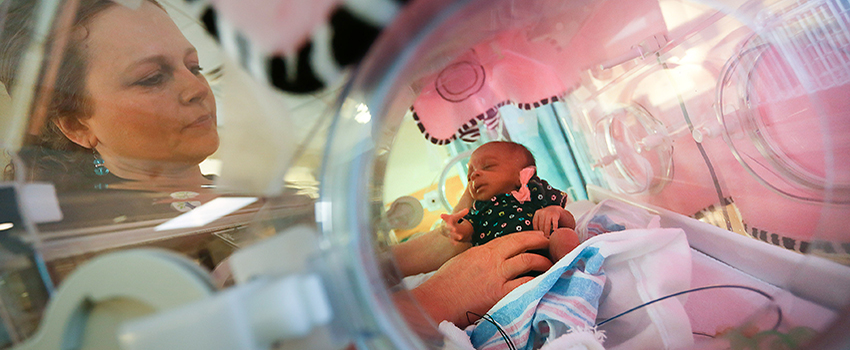
The online Master of Science in Nursing (MSN) degree program helps students prepare for opportunities for specialization in a variety of fields. Nurses build on their academic and practical credentials, using this knowledge to identify and solve patient care issues, leading to better health outcomes for individual patients and for society as a whole. Leadership, administrative, and quality improvement skills are incorporated throughout the program.
All MSN degree coursework is offered online. Students may continue to work while completing degree requirements. As with all South online programs, faculty members are available to support students via phone, email or using other forms of technology.
A state of the art simulation skills lab on campus helps students refresh and master skills and competencies required for the specialty.
Four of the courses in the master's degree in nursing program are offered at a doctoral level, so that students moving on to a Doctor of Nursing Practice program will have already completed 12 credit hours required for the degree.
The College of Nursing has several pathways to enter the online MSN program to accommodate many educational backgrounds.
- Post BSN
- RN to MSN (for associate degree or diploma prepared nurses who have a baccalaureate degree in a field other than nursing)
- Post Graduate Certificate (for MSN prepared nurses who are interested in certification in a new specialty area)
Upon completion of the Master of Science in Nursing program, graduates should be able to:
- Integrate current and evolving knowledge from nursing science and related disciplines while incorporating clinical judgement and innovative nursing practice at an advanced level
- Formulate holistic, person-centered, and culturally inclusive advanced-level nursing care for individuals, families, and communities
- Analyze the impact of social determinants of health on individuals, families, and communities within the healthcare delivery continuum at an advanced level using principles of collaboration and advocacy to improve health outcomes across populations
- Analyze, synthesize, and integrate nursing knowledge at an advanced level to improve healthcare and patient outcomes across populations
- Adopt and integrate strategies and quality improvement principles that ensure a culture of safety in a high-quality care environment
- Facilitate collaboration and communication with individuals, families, communities, and interprofessional teams to deliver advanced-level, person-centered care and achieve shared goals and improved health outcomes
- Integrate systems knowledge, evidence-based practice, and innovative strategies to enhance care delivery, promote cost-effectiveness, and optimize outcomes across the continuum of healthcare
- Integrate informatics and healthcare technologies to promote the delivery of high-quality advanced nursing care and to facilitate gathering and analyzing data, clinical decision-making, communication, and documentation
- Exhibit a professional identity in advanced nursing that includes ethical practice, accountability, and adherence to laws and regulations, through a participatory approach to care in service to individuals, community, and the profession
- Demonstrate advanced professional maturity and continuous leadership development by engaging in self-reflection, lifelong learning, and personal well-being that fosters a spirit of inquiry and flexibility in complex healthcare environments
Organized within the graduate school at the University, the College of Nursing has several pathways, specialization, and sub- specialization options within the MSN program. In addition to admitting baccalaureate- prepared registered nurses, the college offers a special pathway for highly qualified associate degree and diploma nurses who do not hold a baccalaureate degree, and tracks for MSN-prepared nurses who are interested in certification in a new specialty area.
This pathway is available to persons who are registered nurses and have a baccalaureate degree from a regionally accredited institution in a discipline other than nursing. Students in the RN - MSN pathway follow the same degree requirements and progression policies as students in the MSN track for BSN prepared RN's with the addition of the courses listed below.
NU 506 - Evidence-Based Practice & Informatics for Professional Nurses 4 credit hours
NU 507 - Leadership & Management Roles for Professional Nurses 4 credit hours
NU 508 - Clinical Prevention and Population Health for Professional Nurses 4 credit
hours
The Nursing Post-Graduate Certificate Program is designed for registered nurses with a graduate degree in nursing who seek academic preparation in a new specialty or subspecialty area of advanced practice nursing. Nursing Post-graduate certificate students can select any of the specialty options offered by the program. Each certificate program is designed to be in compliance with national certification requirements including required support courses, didactic specialty courses, and clinical hours.
Several concentration areas are offered to meet the career goals of students. Students may prepare as a clinical nurse leader or for advanced nursing practice in one of the nurse practitioner roles or the clinical nurse specialist role. Available NP include Adult- Gerontological Acute Care Nursing, Adult-Gerontological Primary Care Nursing, Dual Role (Family Nursing/Adult-Gerontological Acute Care Nursing), Dual Role (Family Nursing/Emergency Nursing), Family Nursing, Neonatal Nursing, Pediatric Acute Care Nursing, Pediatric Primary Care Nursing, Psychiatric Mental Health Nursing, Women's Health Nursing. Clinical Nurse Specialist is available in Adult-Gerontological Nursing. Concentrations are also available for students pursuing careers in Clinical Nurse Leader, Executive Nursing Administration and Nursing Informatics.
Sub-specializations are available in Addictions Nursing, Advanced Forensic Nursing Care, Cardiovascular, Clinical Lipidology, Nurse Educator, Palliative Care, Social Determinants of Health and Health Disparities, and Trauma-Informed Integrated Behavioral Healthcare. Emergency Nurse Practitioner is offered only as a post graduate certificate to student already certified as a Family NP. See the MSN section for additional course listings.
- The MSN program is an online program. Coursework is completed online and clinical hours can be completed in your region with an approved Preceptor.
- Nurse practitioner track students are required to report to the CON for about 3-5 days for orientation. Additional onsite visits may be required and are listed on the specialty track’s web page. Please refer to the Available Tracks within the MSN program.
- GRE and/or MAT– not required
- Letters of reference – not required
- All MSN students pay the same tuition rate: Web Course Tuition for Graduate Students
- All requirements for the MSN degree must be completed within five calendar years from admission
- Additional requirements for admission are located in the University of South Alabama Undergraduate/Graduate Bulletin.
- Students are responsible for costs related to the required admission background check and drug screen. Students are responsible for all travel costs for any required on-campus visit and for travel costs to clinical sites.
- Students are responsible for all costs related to monitoring/proctoring tests and identity authentication when required by a course.
- Admission is contingent upon the college's ability to secure an approved clinical site by the end of the first semester of program enrollment. Students are encouraged to secure their own clinical placement within an acceptable geographical area if desired. Submission of a formal letter of commitment will be required to verify guaranteed placement for future clinical rotations. If a student is unable to secure an acceptable site within their own geographical area, the college will work to identify an appropriate clinical placement which must be accepted by the student.
- Initial course registration is contingent upon the student's acceptable completion and results of the following requirements: Acceptance Packet, Drug and Background Screen, and Required Documents and Attestations within the Medical Documents Manager. If a student is unable to meet the initial registration requirements, they may transfer their first semester of enrollment to a future semester.
- Applicants should have two years of nursing experience as required by all specialty tracks prior to beginning clinical rotations. One year of experience is required for admission to the program. The remaining one year experience may be obtained while completing core and support courses. Some specialty tracks may have additional professional experience requirements. Students who have not obtained the requisite experience prior to the first clinical term will not be allowed to progress until the requisite experience is obtained.
- CON graduate programs are not approved in NY or SD. Graduates will not be able to obtain APRN licensure in these states.
Contact Information
For all inquiries related to the admissions process: congradapp@southalabama.edu
For all current and continuing students: congrad@southalabama.edu